

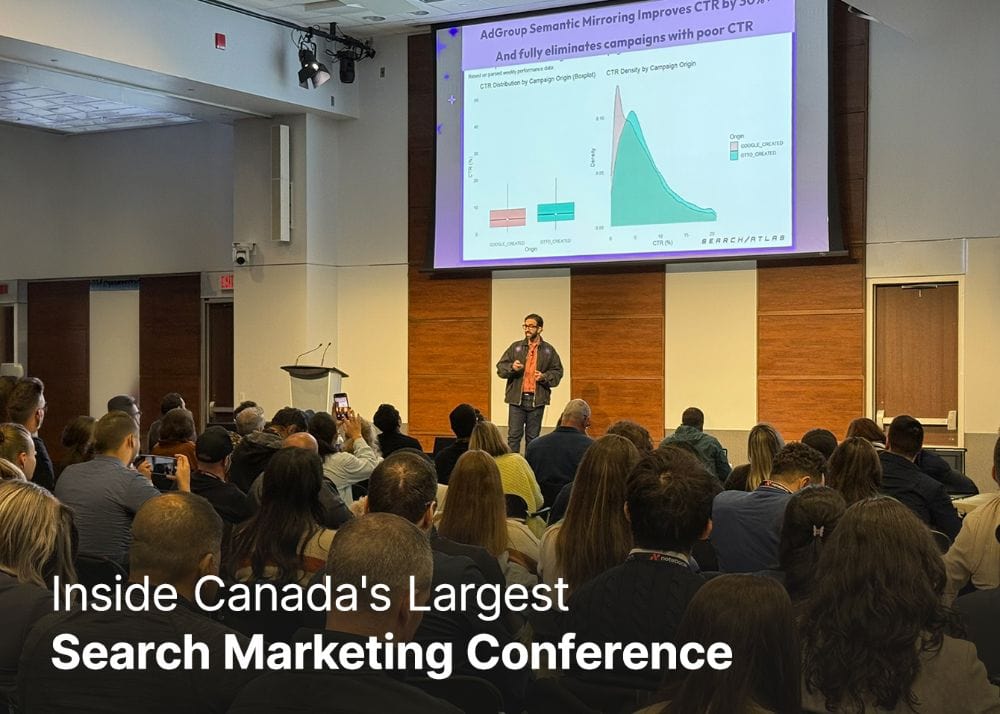
Last week, the EnvisionUP team spent two days at SEO IRL 2025 in Toronto for Canada’s largest search marketing conference.
We sat down with some of the world’s leading search experts who are actively testing what works in AI search right now.
Not theory. Real strategies with real results.
Here’s what matters for your business and what you need to do about it.
Numbers That Got My Attention
The data from the conference was incredible. Based on multiple speakers from the conference, here are the most eye-opening stats:
ChatGPT Search is only 2% of Google’s search volume. That said, it’s growing fast, and your customers are already using these tools to research your business.
92-94% of AI overview sessions result in zero clicks. According to research from Semrush, when most people get their answer from AI, they don’t visit your website. They just move on.
Only 40% overlap between traditional search results & AI overviews. These are fundamentally different systems that pull from different sources.
What This Actually Means for Your Business
Your customers are already using AI chatbots to ask questions like “What’s a trustworthy plumber in Calgary?” or “What’s a typical cost for emergency HVAC repair?”
They’re also asking Google AI about what to do when something breaks. In fact, they’re using voice search in their car to find a provider near them right now.
Think about that.
Your potential customer gets their answer, gets a short list of providers, and makes a decision… without ever visiting your site.
The Good News: You Can Show Up in These AI Answers!
The digital marketers for home service businesses that show up across these new channels, while maintaining strong traditional SEO, are the ones who’ll keep growing.
Here’s what’s working right now.
1. Make Your Information Easy for AI To Find
AI systems love structured, clear information. That means:
Update your Google Business Profile completely. Fill out every field: services, hours, service area, photos, and emergency contact info. AI systems rely heavily on this data when answering local queries.
Keep your NAP (Name, Address, Phone) consistent everywhere. AI tools pull from multiple sources. Inconsistent information means you might not show up at all.
Add structured data to your website. This is technical, but worth doing. Schema markup helps AI understand what you offer, where you serve, and when you’re available. According to Casey’s SEO, combining LocalBusiness schema with Service, Review, and FAQ schemas is the most effective for search engines to understand your business.
2. Answer the Questions Your Customers Actually Ask
When someone types into Google, they might search “Calgary plumber.” But when they talk to ChatGPT or use voice search, they ask full questions: “Which plumber is open now near me?” or “How quickly can an HVAC technician respond in SE Calgary?”
Create content that answers these conversational questions:
- “What to expect when your furnace goes out”
- “How to choose an electrician in Calgary”
- “Average cost of drain cleaning in Calgary”
- “What questions to ask a plumber before hiring”
Write these answers clearly and directly. Use short paragraphs, bullet points, and clear headers. Both traditional search and AI systems prefer this format.
3. Build Trust Signals That Matter
Reviews matter more than ever.
The business with 50 five-star reviews is far more likely to show up in an AI-generated answer than one with only five reviews (SEO IRL, 2025), even if the second business ranks higher in traditional search.
Encourage satisfied customers to leave reviews on Google. Make it easy. Send a follow-up email with a direct link.
4. Rethink How You Measure Success
Here’s the uncomfortable truth: you might see fewer website visits even as your business grows.
If AI answers the question and lists your business as one of three recommended options, the customer might call you directly without ever clicking through to your site.
Track these metrics instead:
- Phone calls (use call tracking)
- Form submissions and chat conversations
- Direct bookings
- Brand searches (people searching for your business name specifically)
- Review volume and ratings
Traditional “organic traffic” might decline, but if calls and bookings increase, you’re winning.
Don’t Abandon What’s Working
This isn’t about choosing between traditional SEO and AI optimization. You need both.
Keep doing the fundamentals:
- Maintain a fast, mobile-friendly website
- Create useful content about your services
- Build local citations and directory listings
- Earn backlinks from local news and industry sites
But layer on these AI-friendly tactics:
- Structured data and schema markup
- Conversational, question-based content
- Complete, accurate business listings everywhere
- Strong review generation processes
What to Do Next
Ready to start optimizing your local SEO? Start here:
1. Audit Your Google Business Profile
Fill in every blank. Add photos. Update your service area and hours.
2. Check Your NAP Consistently
Search for your business name and look at how your information appears across different sites. Fix any inconsistencies.
3. Create an FAQ Page
Pick the five questions customers ask most often and answer them clearly. Use conversational language like someone actually talks.
4. Create a Review Request Process
After every completed job, send a simple email thanking the customer and asking for a review with a direct link.
5. Start Tracking Phone Calls
If you’re not already, use call tracking to measure which sources drive actual leads.
Summary
The search landscape is changing faster than ever. Your customers are already using AI tools to research and find service providers.
The businesses that adapt—that make their information easy for AI to find, that answer real questions clearly, that build strong trust signals—will capture these customers.
The ones that don’t will wonder why their phone stopped ringing even though they “do SEO.”
Which one do you want to be?

Get Started Today
Start getting the online leads your quality business deserves today. Get a free no-obligation initial 30 minute consultation from one of our Google Certified Experts.
An EnvisionUP expert will respond within one business day or less with the next steps.